Wednesday, December 12, 2012

The Hipster Rhetoric


It began in the early 1940s with the original hipsters. These pioneers rebelled against traditional views of society, fighting to maintain their youth in a time of war and uncertainty. While America was fighting the world wars, Communism, and the Cold War, the original hipsters fought to find their place in the world. In the 1960s, hipsters reappeared, reborn with flowers in their hair, acid on their tongues, and messages of peace and love. Much like their predecessors, hippies bloomed from a time filled with war and hate. Young men faced the daily fear of being drafted and sent thousands of miles away to die while, at home, the Civil Rights Movement was in full swing. Hippies strove to end this strife, choosing instead to love one another. These young men and women rebelled from conventional society in order to show that they did not support the state of things in America and that they wanted a change. It proved that they were not alone. They found companionship. Eventually the hippie movement died away and hipsters faded from the scene. Until now. Donning their skinny jeans, mustaches, and deep-v’s, the hipsters are back with a vengeance. Fighting for… What exactly?

The Hipster Movement is one that is difficult to define, mainly because those that make up the movement consistently deny the fact that they are hipsters because they “don’t believe in labels.” There are many definitions of a hipster. Simply, Time Magazine says the term Hipster is used to “describe a generation of middle-class youths interested in an alternative art and music scene” (Fletcher). Adbusters says about hipsters, “today we have the 'hipster' – a youth subculture that mirrors the doomed shallowness of mainstream society” (Haddow). One of the main difficulties in defining a hipster is that so much of the definition relies on the stereotypes of the culture. However, for this paper I have come up with my own working definition of what it means to be “hipster.”

A hipster follows the typical stereotypes of a hipster. In other words, you can tell a person is a hipster just by looking at them. A typical hipster will wear clothes because they think they are funny or ironic. For example, a hipster might don a gas station wolf-howling-at-the-moon t-shirt because they want to make fun of that culture. However, what they fail to mention is that they secretly think it’s cool. Hipsters will often wear things outside of the social norm because they want to be cool. They want to be at the front of the current trends. A true hipster will only do something until it ends up in mainstream media. The minute something becomes popular, the hipster moves on to something new and original. Oftentimes, the “new and original” thing many hipsters move on to is something that has already been done and forgotten, such as their love for vinyl and big, bulky Buddy Holly glasses. The thing that separates a true hipster from those with hipster tendencies, however, is their “I’m better than you” attitude. A true hipster won’t be seen with non-hipsters. A true hipster will hold on to their beliefs with a closed-minded fist, convinced that they are better than anyone else because of their alternative political beliefs.


This clip from Portlandia perfectly illustrates my definition. It depicts a hipster struggling to stay in front of the "cool curve" by only going to places and doing things that were new and hip and all that jazz. The minute he saw the uncool businessman, the epitome of all things hipsters hate (sell-outs who follow traditional views of success in society, work for corporations, etc.) he declares that "it's over!" and moves on to something new. 

The hipster rhetoric is an interesting one insomuch as the movement continues to grow and gain followers even though its very people are so ashamed by the hipster ideals that they themselves do not admit to being hipster. It is near-impossible to hear a hipster openly admit to being hipster, and yet they still cling to the hipster ideals with all their might, believing themselves to be above the rest of the world. Although it is a well-known idea that the hipster movement is all hot air and they really have nothing to contribute, still the movement grows and flourishes. Why is this? What is it about their rhetoric that makes it so appealing to young people, and yet so distasteful at the same time? 

The hipster rhetoric is very appealing from the outside. Hipsters believe in individualism. They strive to stick out from the crows, wearing clothing different from traditional society, picking up atypical hobbies such as seashelling (as the video above shows), using vintage cameras for photography, "street art" (graffiti), or painting abstract art pieces. They often major in things such as philosophy, history, writing (haha...), religious studies, anything that does not reflect the modern views on success (such as being a doctor or engineer might) because they are pursuing their "passions." These are the ways that hipsters reject modern society and become what they want to become. They are individuals trying to express themselves in a society that does not cater to that mindset. 

Except they aren't. Hipsters do what they do because they think it's cool. If a hipster was truly doing what they do because they wanted to, they would look different. There would be no definition of a hipster, because they would each have their own individual style and there would not be enough in a group in order to form a label. Hipsters follow other hipsters in order to stay "cool." They don't know what they stand for or why they stand for it. They do it because it's cool.

Take, for example, the stereotypical hipster love for Starbucks. Hipsters live for Starbucks. I, personally, have known many hipsters who keep their Starbucks cups in order to pour their home-brewed black coffee into their Starbucks cups in order to look as though they ordered Starbucks that morning. Starbucks is not just a coffee shop, but part of the hipster look. It's an aesthetic. However, this love for Starbucks sharply contradicts their hate for corporations. Hipsters live for local. They want their food organic and chemical-free, their chickens free-range and fresh, and they want to support the mom and pop shops. They get fired up when their favorite, underground bookstore gets replaced with a Borders. But they love Starbucks, one of the biggest corporations in America. Their daily purchases go against everything they are "fighting for." This goes to show that hipsters, although loud and obnoxious, don't know what they are talking about or what exactly they are fighting for.

This hypocrisy can be seen in this video from The Daily Show With Jon Stewart. It depicts the Occupy Wall Street movement and those who are a part of it. As the video goes on, it becomes apparent that those involved don't know exactly what they are fighting for, they just know the "cool" people are doing it.

http://www.thedailyshow.com/watch/wed-november-16-2011/occupy-wall-street-divided  

The protesters in this video have an inconsistency when it comes to their arguments. They say one thing and do the exact opposite. This completely derails their argument and makes it so their audience cannot trust them.

This video shows exactly why the rhetoric of the Hipster Movement does not work. In order to be successful rhetorically, the speaker must gain the trust of the audience. They must have some sort of ethos. Hipsters have lost any ethos that they may have had because of their hypocrisy. They have no hope of gaining back that trust because they have no idea that they've lost it.

Another issue with their rhetoric is that their audience seems to be each other. The things that they wear, the issues that they fight for, and the hobbies they develop, as I said before, are only to be considered "cool," but not by the rest of society, whom they have rejected, but by each other. They tell each other things that they know the other person will want to hear. They care only for the opinion of other hipsters.

This is where I think rhetoric often fails. This same issue can often be seen in the political realm. Too often, politicians focus only on the audience of their party. They know what this audience want to hear and so they give it to them. They fail to focus beyond this audience, and are therefor unable to convince more than this audience of their side. For example, during this election, Romney said some things meant for a very specific audience: his financial supporters. He was speaking to a very specific group of upper class republicans. In order to gain their support, he said things that they wanted to hear about Obama voters. However, once the video was leaked, it became quickly apparent that this rhetoric was not meant for a wide audience and it was incredibly detrimental to his campaign. It is the same with the hipsters. Not only is their audience very narrow, but it is towards people exactly like them, much like in the Romney incident, and, therefor, they are unable to persuade others outside of their culture to hop onto their movement, understand their style, or think that they're "cool."

On the other hand, this is a movement that continues to grow. I myself have been accused of being a hipster on numerous occasions, more recently learning that many of my friends consider me the most hipster person they know. This is a common realization many come to have that they, in fact, may be hipster and they didn't realize it. Last year, the Bozeman Daily Chronicle wrote an article exploring just that. In the article, they interviewed a few hipsters in denial. Specifically, they said, "Lilly Herro, wearing skinny jeans and boat shoes, admitted she may be a closet hipster. Her already short hair now sports steps, or razor cuts, up one side – because she thought they were funny" (Hergett).

So why, even though it is shameful to admit, does the hipster rhetoric tend to continue to gain followers, even those such as myself who grudgingly admit to having multiple hipster tendencies?

It all comes down to the visual rhetoric. Although the stuff spewing from their mouths is blatantly hypocritical, they have an undeniable "cool" quality that is difficult to ignore. The true hipster adopts an I-don't-care attitude which almost creates their "coolness." It is not necessarily the clothes they wear that creates this attitude, but the way that they wear these clothes. The way that they act about their hobbies. Because they go against social norms, they stand out, and they look, if not good at least interesting, doing it. No one wants to get lost in the crowd. Hipsters don't. Even if the individual hipster may not stand out in the hipster group, the movement itself has gained a lot of attention.
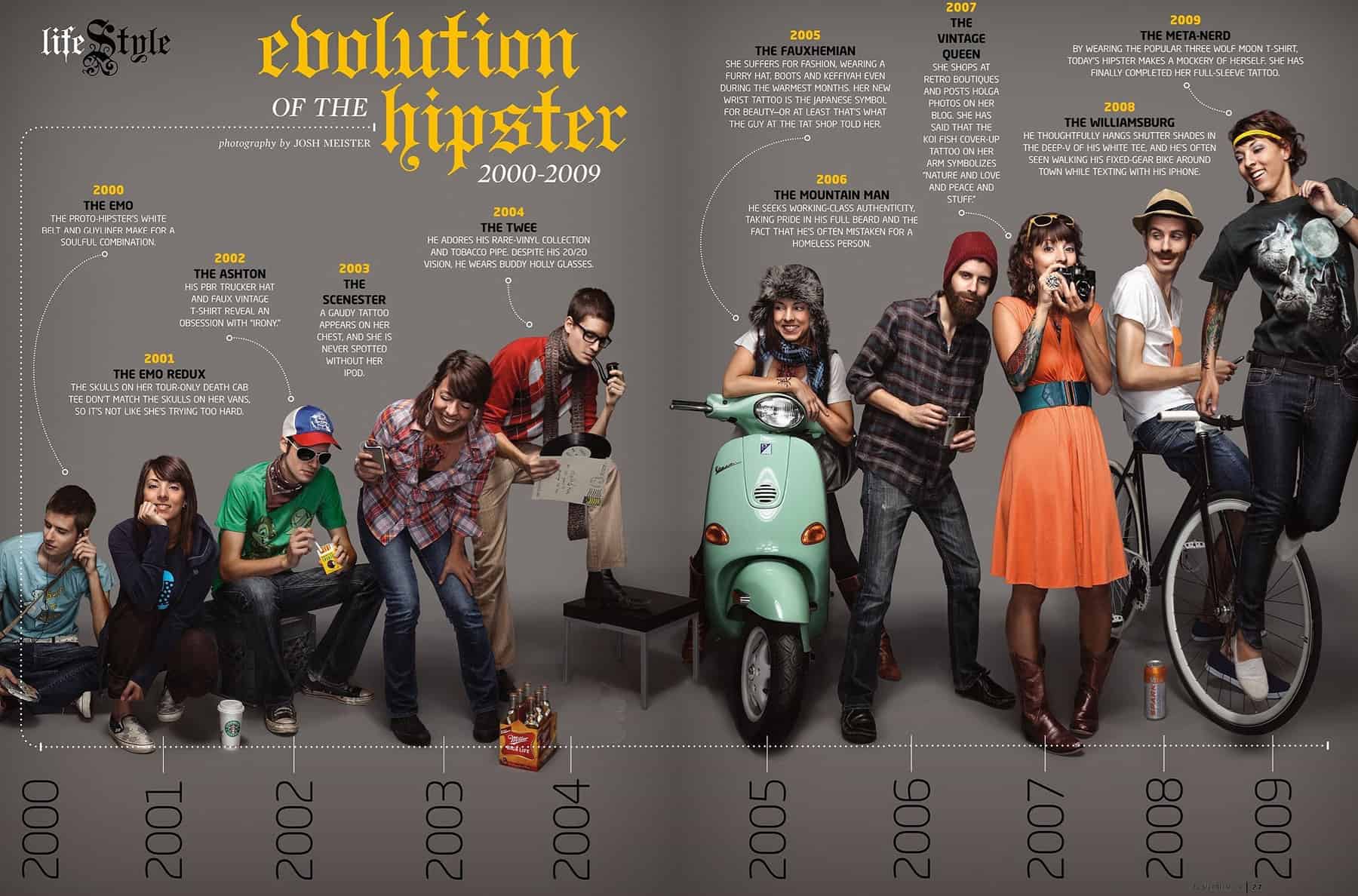
http://dailyinfographic.com/wp-content/uploads/2010/12/hipster.jpg

Here we can see the visual rhetoric of the hipster. The look of the hipster goes beyond mere clothing and accessories to the very way they stand. Hipsters often adopt a bad posture (like the guy on the bike), stand duck-footed (like the girl with the camera) sit on the floor in places where you should probably use a chair (the first dude). The visual creation the hipster tries to pursue is all in the name of not caring. At all.

From looking at the hipster movement, I have come to realize how important the visual aspect of rhetoric is. Rhetorically, hipsters fail. They have become the butt of multiple jokes, the laughing stock of society, the group that is looked down upon. Even the hipsters hate hipsters, as you will be hard pressed to find a self-identifying hipster. However, visually they work. Multiple clothing stores have made it copying the hipster aesthetic such as Urban Outfitters and Anthropologie. Their movement continues to grow due to those who adopt the hipster style without the hipster attitude behind it. The hipster movement works because of its aesthetics. 


CITATIONS

Evolution of the Hipster. N.d. Daily InfographicWeb. 12 Dec 2012. <http://www.bing.com/images

     /search?q=Hipster&view=detail&id=8C026E18C5B8174A6F8F5AFE393085DA11F64CCE&

     first=36>. 

Fletcher, Dan. "Hipsters." Time 29 Jul 2009, n. pag. Web. 12 Dec. 2012. <http://www.time.com               
     /time/arts/article/0,8599,1913220,00.html>.

Haddow, Douglas. "Hipster: The Dead End of Western Civilization." Adbusters 29 Jul 2008, n. pag.   

     Web. 12 Dec. 2012. <https://www.adbusters.org/magazine/79/hipster.html>.

Hergett, Rachel. "Is It Hip To Be A Hipster?." Bozeman Daily Chronicle [Bozeman] 12 Oct 2011, n. 

     pag. Web. 12 Dec. 2012. <http://www.bozemandailychronicle.com/news/lifestyles

     /article_e589dcac-f462-11e0-aa4b-001cc4c002e0.html>.

Monday, November 19, 2012

Final Proposal

I thought that the whole concept of visual rhetoric to be incredibly intersting. People can say so much even before they open their mouths. What are people trying to say when they portray themselves a certain way? What does a hairstyle or t-shirt represent about a person? How deliberate is this message?

I want to focus more specifically on the hipster movement. What is the rhetoric behind this movement? The hipster movement is a very interesting one because hipsters are deliberately trying to say something in the way they dress, the items in which they invest, the way they act. However, I don't think that they are successful in their representation. They strive for individuality and non-comformity, and yet they have conformed to their movement. Marketing helps in this, as they have found what it means to be "cool" and caters to this mindset.

In my paper, I'm going to look at the Hipster movement from a rhetorical perspective, try to analyze exactly what they are trying to say, and whether or not they were successful in their rhetoric.

Tuesday, October 30, 2012

The Power of Coca-Cola


This ad is basically saying that you can depend on Coka-Cola because it will have great quality every time. By showing a line of fresh Cokes coming straight from the factory, it shows that, not only is their company going strong and will be here for a very long time, but you can be confident in the fact that each Coke you drink will have the same quality. It also suggests that once you have one Coke, you will  want another because it's so good. Coke must be able to provide so many beverages because they have the demand. The bottles are also covered in condensation and look incredibly refreshing. It almost makes the viewer want one right now. The cream-colored background also brings the viewer's attention to the brown bottles, focusing their attention, as well as on the logo at the bottom of the page. They are careful to specify that consumers of Coke may call it either Coca-Cola or Coke. This kind of brings the consumers into a type of a club. The real Coke drinkers know to call it by its shorter, cooler nickname, rather than the original mouth full. This ad portrays Coca-Cola as a reliable, trustworthy company who does not only want you as a casual consumer, but as a loyal member of a club made up by those who know the "true" name. It makes the consumer feel exclusive and special, and makes it seem as though it is a relationship rather than just production and consumption.

Visual Rhetoric

http://www.stanford.edu/~steener/f03/PWR1/whatisvisrhet.htm

I thought that this post was really interesting, because it brought me back to my senior year in high school when I was looking for colleges. I remember, as a lazy high schooler, coming onto a college website, and the first thing I would do was go to the photo albums and see what the school looked like. If I didn't really like the photos, I would dismiss the college. It's probably not the best way to look at colleges, but, especially at schools that were far away, it was the only visual I would get of the college. Images are incredibly important while trying to promote your college. In these Stanford photos, they try to portray a strong learning environment while showing that their students are real and laid back and just like you!

I think it's funny, though, that this web page is discussing visual rhetoric while the page itself isn't exactly visually pleasing. Although it is simple and easy to read, it does not show great prowess in the area of web page design. If I was a student looking at this page and trying to decide if this is a school I was interested, I might be put off by this page, just because of its aesthetic. There's nothing horribly bad about it, but it isn't visually interesting and almost portrays laziness.

Wednesday, October 17, 2012

Presidential Debate: Take Two

Yeah... I was pretty disappointed.

Seriously, guys? You just sat and bashed the shit out of each other, having no respect whatsoever for each other, the mediator, or the audience who had taken the time to write questions to ask you.

Neither of them really respected the questions they were asked. The mediator kept having to bring them back to the questions asked, while they talked about whatever the hell they wanted to.

Both of them were incredibly on edge, it seemed to me. Their arguments weren't so much about what they were going to do for America if they were elected, but rather about what their opponent wasn't going to do, or what their opponent lied about, or how their opponent is just an all-around bad guy.

Both of these men are career politicians, and this debate kind of concreted this for me. Neither of them really care about America. They say what they say in order to be elected. I don't trust either of them. Both of them are accusing the other of lying, so someone has to be. I think both of them are. This presidency is only a promotion in their eyes. They don't actually care.

Anyway, now that I've sufficiently ranted about these two dumbasses...

Watching their body language, Obama did a good job of looking at Romney the entire time... Until Romney started getting in Obama's face. They began arguing, both standing, both very aggressive. At first, they both did a good job of holding their ground, but then Romney challenged Obama on a specific issue, and Obama turned from Romney and started addressing the crowd instead. I think that this was a weak move on Obama's part because Romney was the one who challenged him, so he should have faced Romney, who was staring Obama down as if his life depended on it. And then, when Romney pressed the issue further, Obama backed down and returned to his seat. At this point, it doesn't even matter what they were talking about, Romney won that exchange. Romney seemed to be much more aggressive than Obama in this respect.

I was pretty much disgusted with this debate. I have no respect for either candidate because they have no respect for each other or their audience. This was kind of a downer. Oh, politics. Lovely.

Sunday, October 14, 2012

Presidential Rhetoric

Ah! I'm sorry I thought I posted this on Friday! But I guess I didn't... Ha...


Meghan O’Neal
Understanding the Audience
A good rhetorician always keeps his or her audience in mind. Words mean nothing presented to the wrong group of people. Romney and Obama both have a strong understanding of their audience. They use their audience in very different ways, however. While Romney caters to a very specific audience (conservatives, especially Christian conservatives), Obama tends to use his audience as a rhetorical tool, raising excitement and including them in his speeches.
            On August 14th , Romney spoke to a group of Ohioans on his campaign trail. In this speech, he was speaking almost exclusively to Republicans and those who oppose Obama. He built ethos for this audience by being introduced by the governor of Ohio – a Republican – and the Senator representing Ohio – also a Republican. This was a wise move on Romney’s part because these were two politicians who already had the trust of Ohio. When he steps up to go into his speech, he already has some of the trust of the voters of Ohio, instead of having to build ethos for himself.
            The contents of Romney’s speech also cater to the Republican voter. Multiple times he mentions God. He mentions America as “One Nation under God” and in his conclusion he states, “God bless you. And God bless the United States of America” (Romney). This is a strong statement, not only showing his faith, but also showing that God is part of the United States and will stay a part of the United States if Romney is elected. Keeping God in the American government is a very Christian Republican idea. Although many Christians hold this idea in the highest regard, and for many Christians this can be the most important issue, it serves to alienate a lot of American voters who do not share this faith and who do not agree with it. Mentioning God in his speech was a very conscious decision made for his very specific audience.
            Romney also built up a sense of traditional patriotism in his speech, which is also more of a Conservative ideal. He says, “American history has been a story of the many becoming one – uniting to preserve liberty, uniting to build the greatest economy in the world, uniting to save the world from unspeakable darkness” (Romney). These ideas of America as the greatest country in the world and preserving liberty and saving the world is very conservative. Looking at recent trends, such as the Tea Party movement and the push back towards Reaganomics, Republicans have been looking to return to a more traditional America. A more patriotic America. He is bringing a strong sense of pathos to his conservative voters. His repeated use of the word “uniting” as well as the idea that America has the power to save the world and is the greatest country in the world is a very traditional patriotic idea. It builds emotion and pride within the audience. It has the strong enthymeme that this is the America we should be, and this is the America that Romney can create.
            Obama opens his speech to the people of Virginia on September 27th similarly to Romney in that he tries to build ethos for himself. However, instead of being introduced, he drops a few names, thanking those who have helped him during the course of the campaign. This serves to not only build a trust with his audience as he points out the names of those who support his campaign effort, but it also humbles Obama, building more pathos. The audience trusts him more because he humbles himself. He seems to say, “I am not doing this alone. These are the people who have helped me and I am grateful” (Obama). This contrasts with Romney’s introducers because Romney had others come in to build himself up, while Obama built himself up by building up others. 
            Throughout his speech, Obama continues this idea that he cannot do this alone. He consistently includes the audience and his voters by using “we” instead of “I.” He attributes his successes to his voters, which makes them more involved in the campaign process. This serves to continue Obama’s humility as well as unifies the audience. He is saying that together we can make a difference, which makes the audience feel more involved and active in the entire process. He further brings the audience in by asking questions and waiting for the audience to respond, which they do, loudly and in unison. This creates more of a conversation between Obama and his audience, bringing them together and adding to his idea that we are all in this together, and he needs his voters in order to be successful. Obama also repeats phrases in a predictable manner which makes it easy for his audience to follow along, and even join in when they hear these phrases. After mentioning shortcomings of Romney, the audience would boo, and to that, Obama would reply, “Don’t boo. Vote” (Obama). Not only does this go along with Obama’s theme that he can’t do this alone, and that he needs his voters, it also gives his audience the feeling that they are important and their voices do make a difference. The audience also began to join in once they heard the familiar words, “Don’t boo. Vote,” and towards the end of the speech, Obama would leave this open-ended, saying “Don’t boo,” and the audience would finish, “Vote!” The back and forth conversation, the vocality of the audience, and Obama’s ability to keep the emotion and passion of the audience going created a very pathetic speech. The audience was very emotion-driven, and by the end of the speech, they were incredibly passionate and excited about Obama and everything he had to say.
Obama had a very strong understanding of his audience and, therefore, was able to use his audience in order to make his point of unification and togetherness. He brought the audience together, much like he said he wants to bring America together. He made sure the audience knew that he could not do this without him, and created an audience of, not just voters, but fans of Obama who cared about him as a person, not just a president. He became more relatable because of his open conversation with his audience. Towards the end, it didn’t matter what he said because he had the audience’s complete loyalty.
Romney and Obama had very different approaches to their audiences. Romney knew his specific audience and carefully crafted a speech for that audience, while Obama used his audience as a rhetorical tool in order to create a conversation, unify the audience, and build emotion. So, who was more effective?
Both candidates knew their audiences. They both made use of strong demonstrative arguments, tearing each other down and trying to show how they would be better than the other. Each had key words which they knew their audience would want to hear; Romney used any opportunity to mention coal, God, America, jobs, family, and the middle class, while Obama focused on being fair, what “we” could do for America, and jobs and the middle class. These key words served the purpose of reminding the audience of each candidate’s priorities, but it also shows that each candidate had a strong understanding of what the audience wanted to hear, and so they gave it to them. This is a purely emotional tactic, intended to bring a sense of loyalty to the candidate. I think, however, that Obama does a better job of catering to a wider audience, while Romney tends to alienate groups of people because of his mention of God. Obama also unifies his audience, bringing them in and creating an interactive atmosphere. This builds the audience’s emotions as their passion feeds off of his and each other’s. Once the audience is emotional, it doesn’t matter what Obama says because they get caught up in the excitement.
Both candidates knew their audience and used that knowledge. However, Obama seemed to have more of a grasp on an audience beyond his supporters in Virginia. He worked for unification within his audience, which provided the enthymeme that, if re-elected, he would work for the unification of America. The point to his speech was that Americans need to work together in order to create a better, more fair America for everyone. His audience served as an example of that as he and the audience worked together to build emotion and support for what he was saying. Romney, on the other hand, made the choice to speak to his very specific audience. Although this was an effective choice for the audience he chooses, it is not necessarily the best rhetorical choice in terms of the moderate vote. Overall, Obama made more effective use of a wider audience while Romney was only effective within his specific audience.


 Citations
Obama, Barack. "Virginia Beach, VA September 27, 2012." 09-27-2012. Address.
Romney, Mitt. "Chillicothe, OH August 14, 2012." 08-14-12. Address.
           

Thursday, October 4, 2012

Presidential Debate

This morning as I checked my facebook page, I thought the debate posts were particularly funny. My Republican friends said that Romney won, while my Democrat friends said that Obama won, and my Libertarian friends announced loudly that they both suck and everyone should be a Libertarian.

Personally, I think that they both kind of fumbled on this one. It felt entirely unorganized and more like a high school class room debate than a presidential debate. Neither Obama nor Romney respected the mediator at all (especially Romney, I have to say). It kind of came across as desperate and weak how Romney would just blatantly ignore the time reminders and frantically continue what he was trying to say. At least Obama pretended to be polite as he went well over his time limit.

Neither candidate did a good job of hiding their contempt for each other, either, although they tried their hardest. I didn't really appreciate that. I feel like the entire affair could have been much more professional.

Both candidates did a good job of talking about exactly what they wanted to talk about. Romney wasted no time talking about more jobs, and didn't stop talking about more jobs. He seemed a little unorganized until they started talking about the deficit, where he seemed much more confident and went right into his five point plan. I feel, though, that he focused on his five point plan a little too much during the rest of the debate and didn't explain exactly how it was going to go down.

Obama, obviously, found his stride when talking about Obamacare (I thought that it was funny how he now also refers to it as Obamacare). He definitely played with the emotional part of the system, talking about his grandma and personal experiences.

I was disappointed that there was a lot of opponent bashing. I feel like there was too much "don't vote for the other guy because he does this" instead of "vote for me because I will do this." And whenever Obama said something against Romney's plan, Romney did a lot of flat-out denying.

I wasn't impressed with this debate. It was a lot of the same things I've heard over and over again. Basically, what it comes down to is Obama saying that we should vote for him because he'll keep Obamacare and he has so much more to do, and Romney says we should vote for him because he will make more jobs and he's not Obama.

On another note, I watched the debate on CNN and they had this running graph on the bottom of the screen of a group of undecided voters in Colorado which tracked how they felt about the debate (positive and negative). It was separated by men and women. Throughout the debate, men and women pretty much agreed on what they liked, until the candidates began discussing Obamacare. Here, the women tended to agree with Obama while the men agreed with Romney. I just thought that this was very interesting, especially because the women's vote is a big factor in this election. I know that Obama has been working to get the female vote, and Obamacare is a huge part of this, since it concerns women's health.

Monday, October 1, 2012

Style

Accismus: A feigned refusal of that which is earnestly desired.

     Example:  "Oh, no, I can't take your check for $10,000! That is far too generous!"

Categoria: Opening the secret wickedness of one's adversary before his face.

     Example:  "Can we discuss the happenings between you and the woman you took out to dinner last night who was not your wife?"

Eucharistia: Giving thanks for a benefit received, sometimes adding one's inability to repay. 

     Example:  "Thank you so much for dinner! I've been eating nothing but crackers for three days. I wish I could repay the favor... Someday... Maybe..."

Repotia: The repetition of a phrase with slight differences in style, diction, tone, etc. 

     Example: "I have nothing. Nada. Not a thing. It's all gone. Bye bye. Adios."  


Saturday, September 29, 2012

My Notes

These are just interesting videos and such that I was looking at for my presidential rhetoric paper.
It's really just my notes... Haha.

http://www.mittromney.com/videos

http://youtu.be/YkvN7GCcTVk

 http://youtu.be/erT_1axOAHo

http://www.mittromney.com/blogs/mitts-view/2012/08/mitt-romneys-plan-stronger-middle-class01

At first glance, I'm noticing a huge pattern of families and how Obama has been attacking the average American family. There is a strong enthymeme that Obama just doesn't care about the family and that he is attacking the values of the American family by taking away jobs. These videos show a lot of children. This immediately adds emotion to these videos and adds a pathetic element. Romney is saying that I care about these kids! Obama does not. He does not care about the working man and his family! It has the enthymeme that if you vote for Obama, he will not take care of these families, but Romney will.

I thought that it was particularly interesting that in the first video, they have Obama repeat his piece on how people can open a coal power plant, but it will bankrupt them. They have that in there twice. This clip makes Obama sound as if he is threatening the coal industry in a major way. The video also prefaces the clip for the first time, saying that Obama is attacking the coal workers instead of the actual coal companies. This is very careful word choice on the part of the Romney campaign. It creates this enthymeme that Obama does not care for the individual coal worker and that he is attacking the coal worker specifically. However, Romney knows, Romney understands, and Romney cares. In the video, each shot of a coal mine includes an American flag. This seems to say that coal mining is America. It has powered America for 250 years, and it will continue to power America. Romney cares about families, and he cares about America. Obama doesn't and, therefore, we should vote for Romney.


http://www.barackobama.com/video?source=primary-nav

http://www.youtube.com/watch?feature=player_embedded&v=1pdgHQcWQvc

The first one, I think, is kind of the core of Obama's reelection strategy. I have done this for America so far, but I'm not done! Let me continue! It has the enthymeme that if Romney wins, he will take away everything that Obama has done. We've come too far to allow this to happen! Obama is a step forward while Romney is a step back. It's almost a continuation of his original campaign; he was all about change, and now he's made the change, but he needs more time!

His speech to Virginia was all about "I am one of you!" He opens with a humorous line "If you didn't pay your cable bill." He seems to be saying, "I've been there! I know how it is! I am connected enough to the world in order to make that reference!" I also immediately noticed the way he's dressed. Usually presidents and presidential candidates are dressed sharply in an expensive suit. Here, however, Obama looks professional, but casual, with no jacket and his sleeves rolled up. He is more approachable this way. Honestly, it reminds me of when I was younger and my dad would come straight from work to the dinner table when he had unbuttoned his shirt a bit and was just winding down from the long work day, and I'm sure it reminds a lot of people of that. This goes along with his "I am one of you" angle. He may be the president, but really he's just  a working man with a family, same as you. It kind of reminds me of the fireside chats that FDR used to host. He had the same idea; I'm just a regular American looking to have a chat with my fellow Americans about the state of our country and where we are headed.

This kind of begs the question, is the presidential image changing? What is now presidential? Until now, the president has always been this being who is kind of above everyone, looking sharp in a suit, surrounded by security, untouchable. But this election both Romney and Obama seem to be trying to be more approachable. They are dressing more casually, more hands-on with the voters, and getting to know "regular people" rather than rubbing elbows with the higher-ups. I just think the shift is interesting.

In this Virginia speech, in particular, Obama's speech style is much more informal. He's cracking jokes, using references the middle class understands, such as the cable bill thing, and seems to be chatting it up with thousands of his closest friends. He has very deliberate word choice, using terms like "we" and "you." He said that the health care plan was all thanks to "you" directing it at his audience. He is very careful not to say "I." He is saying that the American public made everything that he did possible, and that together, we can work together to move forward. It makes him humbled, which makes him even more approachable, and acknowledges that America is for the people by the people. This is what America has always been about and what Americans want to hear and seems to say that Obama is an American president who works for the people. Vote for Obama because he works for you, because he is you.

I also got a kick out of his blatant jab at Romney's whole 47% thing. "We do not expect the government to work for us!" His use of "we" here also seems to say that Romney didn't just insult Obama voters, but Obama himself.


Thursday, September 27, 2012

Presidential Rhetoric

I would like to focus my presidential rhetoric paper on audience and how the "flavor" of the argument changes with the audience.

I particularly found the whole Romney and the 47% debacle interesting and entertaining. This occurred because of mixed audiences; Romney intended this speech for a very specific audience, and it all blew up in his face when it was presented to the wrong audience. I want to look at the rhetoric he uses in this instance versus the rhetoric he uses when he is speaking to a wider audience.

I also want to contrast this with Obama's rhetoric towards his audiences. In particular, the video where he shows his support for same sex marriage. Here he also has a very specific audience in mind, however, he is slightly more successful in his address to a very specific audience than Romney was in his. I want to explore why this is and why audience is so important.

Romney and Obama both use completely different rhetoric depending on their audiences. Sometimes this rhetoric is successful and, as we can see in Romney's case, rhetoric to a specific audience can be catastrophic when presented to the wrong audience.

Monday, September 17, 2012

Romney vs. Obama: Battle of the Web Pages


http://www.mittromney.com/
http://www.barackobama.com/

So I decided to compare and contrast the Romney and Obama websites to look at their rhetorical tools side by side.

Visually both websites are kind of the same, showing marvelous, hopeful, patriotic pictures of each candidate speaking to their adoring fans. It's actually kind of funny that both of them are set against glorious blue skies with puffy white clouds. I can only assume this represents the hope and "blue skies" ahead if you vote for this candidate. In their photos, not only do they look strong and powerful (the camera angled from below gives this effect), but their faces are formed in a state of concentration, showing that they have the country in mind... Or something. From the moment you come across the candidates' pages, they scream "Make me your president because I am awesome!"

All cynicism aside, this works to get the voter in the right mindset. A candidate must look presidential and powerful and must be a beacon of hope to all. These photos represent what the candidates will try to bring to the presidency and serve as a first impression for many voters.

The first thing you see on Romney's home page is a giant contest to win a chance to fly with Romney on the campaign plane. I think that this is an incredibly interesting choice. It seems to say, "I care about my voters so much, I want to fly with you!" It gives a sense that Romney cares about the individual. (In reality, I can only guess that this just opens the door to endless spam in your email inbox, but whatever!) Other than that, his home page focuses solely on Romney's plan for presidency. It is a completely logical approach. This makes sense to me; Obama has been president for four years which means that the voters generally know where he stands while Romney is new to the presidential stage and most voters will have had no idea what Romney is all about. He needs to push his issues to gain the voters who agree with him.

Obama's front page, on the other hand, opens with a great big demonstrative banner against the Republicans (take that, Romney!) It's kind of an enthymeme saying that they can do this while the republicans can't. Go team! Obama's front page is dripping with pathetic arguments with pictures of happy people in communities and how much Ohio and Iowa loves him and puppies and butterflies! This also makes sense for his campaign because, as I said before, the public knows Obama as the president. We want to know what an awesome person he is. No one wants to vote a bad guy into office. He also caters to the individual in a much different (and probably smarter and less subtle) way by including pictures of his voters on his page. His page is much more personal than Romney's and makes people think, "Wow! Look at those voters just like me! I can vote for Obama, too!"

Saturday, September 8, 2012

Article

http://www.nytimes.com/2012/09/09/us/politics/obama-romney-battle-plans-set-for-final-charge.html?_r=1&ref=politics

I think that it's interesting to watch the tactics of these two candidates as the race is coming to an end. The voter base is so polarized (people tend to vote more for their party rather than the candidate), so their main goal is to try and persuade the voters with the more moderate views who have not yet made up their mind. Now, it seems that it is not just their words that are important, but their audience. Now, it is key for them to choose their speech locations very wisely in order to spread their "fan base" and gain votes.

Wednesday, September 5, 2012

Socrates Question

So, while reading this piece, the entire time, it was very apparent that Socrates is an incredible rhetorician. He bested Gorgias many times during the course of the discussion, even though many swore that Gorgias was a master of his craft and the greatest rhetorician that could ever be... Blah, blah, blah. Socrates obviously provides a very convincing argument against rhetoric, but he uses rhetoric very well in order to provide his argument. The entire time I read this piece, I had a very hard time following Socrates' argument because it feels hypocritical to me. Why should I believe that rhetoric is always bad and manipulative and questionable ethically when Socrates provides a beautiful example of rhetoric in this piece?

Introduction

Yo! My name is Meghan Amanda O'Neal, and I am terrible at these introduction things... Let's see, then...
I am currently a Senior (yes!) studying writing with a minor in photography. Beyond this year I have no idea what my plan is, so I'm just going to jump off the cliff and see what happens! I'm from La Center, WA (a small town just north of Portland, OR known for its casinos). I came to Montana State University really just for the skiing (although this is the first year I actually have a pass and/or time), but I've kind of fallen in love with the place. I really hope that my future allows me to stick around, at least for a little while. I'm one of those stereotypical "I love to write; writing is my life; ever since I could lift a pen, I have been called to write" writers. Basically, it's my passion and hopefully I can make a career of it (fingers crossed). If not, I guess my cardboard begging sign will be grammatically correct and wonderfully eloquent. My favorite color is purple. My favorite food is anything cooked in under five minutes. I'm a whiskey girl.
Annnnnnd that's about it!

Tuesday, August 28, 2012

Encomium of Helen Question

Why did Gorgias feel the need to remove the blame from Helen? What was his purpose for this speech? Did he do it for Helen, in order to give her the respect she deserves, or was his reasoning more selfish? Did he only want to display his rhetorical ability?

Monday, August 27, 2012

Prewriting

I have many teachers who have sworn on beginning prewriting with charts, charts, charts. You must begin with a general topic, then come up with ideas branching from the broad topic, slowly shrinking the ideas until you have a thesis. this gives a visual of the actual thought process which can help later on in the writing process. There were numerous charts like this, but the one I remember and used the most was a web diagram. In the center would be a broad topic, such as the Civil War, and branching from there were topics pertaining to the broad topic (slavery, Abraham Lincoln, etc.). From there, I could create more branches from these topics until I had my thesis. I have had other teachers who have pushed me to create lists, keeping the idea that I must start with a general idea, then shrink it down until I have a thesis. Once a thesis is formed, across the board, I have always been taught to outline my paper. What will my paper look like? What research is needed in order to fill in the blanks? These prewriting tools have always been taught in order to fully organize my thoughts before I face the daunting blank page. Generally, my teachers have only attempted to give me the tools I need in order to keep everything organized so that, in the end, my paper will be more organized. Prewriting prepares the way for an organized, well-thought piece of writing. No matter the process, the key to prewriting is organization.