It began in the early 1940s with the original
hipsters. These pioneers rebelled against traditional views of society,
fighting to maintain their youth in a time of war and uncertainty. While
America was fighting the world wars, Communism, and the Cold War, the original
hipsters fought to find their place in the world. In the 1960s, hipsters
reappeared, reborn with flowers in their hair, acid on their tongues, and
messages of peace and love. Much like their predecessors, hippies bloomed from
a time filled with war and hate. Young men faced the daily fear of being
drafted and sent thousands of miles away to die while, at home, the Civil
Rights Movement was in full swing. Hippies strove to end this strife, choosing
instead to love one another. These young men and women rebelled from
conventional society in order to show that they did not support the state of
things in America and that they wanted a change. It proved that they were not
alone. They found companionship. Eventually the hippie movement died away and
hipsters faded from the scene. Until now. Donning their skinny jeans, mustaches, and deep-v’s, the hipsters are back with a vengeance. Fighting for…
What exactly?
The
Hipster Movement is one that is difficult to define, mainly because those that
make up the movement consistently deny the fact that they are hipsters because
they “don’t believe in labels.” There are many definitions of a hipster. Simply,
Time Magazine says the term Hipster is used to “describe a generation of
middle-class youths interested in an alternative art and music scene”
(Fletcher). Adbusters says about hipsters, “today we have the 'hipster' – a
youth subculture that mirrors the doomed shallowness of mainstream society” (Haddow).
One of the main difficulties in defining a hipster is that so much of the
definition relies on the stereotypes of the culture. However, for this paper I
have come up with my own working definition of what it means to be “hipster.”
A
hipster follows the typical stereotypes of a hipster. In other words, you can
tell a person is a hipster just by looking at them. A typical hipster will wear
clothes because they think they are funny or ironic. For example, a hipster
might don a gas station wolf-howling-at-the-moon t-shirt because they want to
make fun of that culture. However, what they fail to mention is that they
secretly think it’s cool. Hipsters will often wear things outside of the social
norm because they want to be cool. They want to be at the front of the current
trends. A true hipster will only do something until it ends up in mainstream
media. The minute something becomes popular, the hipster moves on to something
new and original. Oftentimes, the “new and original” thing many hipsters move
on to is something that has already been done and forgotten, such as their love
for vinyl and big, bulky Buddy Holly glasses. The thing that separates a true
hipster from those with hipster tendencies, however, is their “I’m better than
you” attitude. A true hipster won’t be seen with non-hipsters. A true hipster
will hold on to their beliefs with a closed-minded fist, convinced that they
are better than anyone else because of their alternative political beliefs.
This clip from Portlandia perfectly illustrates my definition. It depicts a hipster struggling to stay in front of the "cool curve" by only going to places and doing things that were new and hip and all that jazz. The minute he saw the uncool businessman, the epitome of all things hipsters hate (sell-outs who follow traditional views of success in society, work for corporations, etc.) he declares that "it's over!" and moves on to something new.
The hipster rhetoric is an interesting one insomuch as the movement continues to grow and gain followers even though its very people are so ashamed by the hipster ideals that they themselves do not admit to being hipster. It is near-impossible to hear a hipster openly admit to being hipster, and yet they still cling to the hipster ideals with all their might, believing themselves to be above the rest of the world. Although it is a well-known idea that the hipster movement is all hot air and they really have nothing to contribute, still the movement grows and flourishes. Why is this? What is it about their rhetoric that makes it so appealing to young people, and yet so distasteful at the same time?
The hipster rhetoric is very appealing from the outside. Hipsters believe in individualism. They strive to stick out from the crows, wearing clothing different from traditional society, picking up atypical hobbies such as seashelling (as the video above shows), using vintage cameras for photography, "street art" (graffiti), or painting abstract art pieces. They often major in things such as philosophy, history, writing (haha...), religious studies, anything that does not reflect the modern views on success (such as being a doctor or engineer might) because they are pursuing their "passions." These are the ways that hipsters reject modern society and become what they want to become. They are individuals trying to express themselves in a society that does not cater to that mindset.
Except they aren't. Hipsters do what they do because they think it's cool. If a hipster was truly doing what they do because they wanted to, they would look different. There would be no definition of a hipster, because they would each have their own individual style and there would not be enough in a group in order to form a label. Hipsters follow other hipsters in order to stay "cool." They don't know what they stand for or why they stand for it. They do it because it's cool.
Take, for example, the stereotypical hipster love for Starbucks. Hipsters live for Starbucks. I, personally, have known many hipsters who keep their Starbucks cups in order to pour their home-brewed black coffee into their Starbucks cups in order to look as though they ordered Starbucks that morning. Starbucks is not just a coffee shop, but part of the hipster look. It's an aesthetic. However, this love for Starbucks sharply contradicts their hate for corporations. Hipsters live for local. They want their food organic and chemical-free, their chickens free-range and fresh, and they want to support the mom and pop shops. They get fired up when their favorite, underground bookstore gets replaced with a Borders. But they love Starbucks, one of the biggest corporations in America. Their daily purchases go against everything they are "fighting for." This goes to show that hipsters, although loud and obnoxious, don't know what they are talking about or what exactly they are fighting for.
This hypocrisy can be seen in this video from The Daily Show With Jon Stewart. It depicts the Occupy Wall Street movement and those who are a part of it. As the video goes on, it becomes apparent that those involved don't know exactly what they are fighting for, they just know the "cool" people are doing it.
http://www.thedailyshow.com/watch/wed-november-16-2011/occupy-wall-street-divided
The protesters in this video have an inconsistency when it comes to their arguments. They say one thing and do the exact opposite. This completely derails their argument and makes it so their audience cannot trust them.
This video shows exactly why the rhetoric of the Hipster Movement does not work. In order to be successful rhetorically, the speaker must gain the trust of the audience. They must have some sort of ethos. Hipsters have lost any ethos that they may have had because of their hypocrisy. They have no hope of gaining back that trust because they have no idea that they've lost it.
Another issue with their rhetoric is that their audience seems to be each other. The things that they wear, the issues that they fight for, and the hobbies they develop, as I said before, are only to be considered "cool," but not by the rest of society, whom they have rejected, but by each other. They tell each other things that they know the other person will want to hear. They care only for the opinion of other hipsters.
This is where I think rhetoric often fails. This same issue can often be seen in the political realm. Too often, politicians focus only on the audience of their party. They know what this audience want to hear and so they give it to them. They fail to focus beyond this audience, and are therefor unable to convince more than this audience of their side. For example, during this election, Romney said some things meant for a very specific audience: his financial supporters. He was speaking to a very specific group of upper class republicans. In order to gain their support, he said things that they wanted to hear about Obama voters. However, once the video was leaked, it became quickly apparent that this rhetoric was not meant for a wide audience and it was incredibly detrimental to his campaign. It is the same with the hipsters. Not only is their audience very narrow, but it is towards people exactly like them, much like in the Romney incident, and, therefor, they are unable to persuade others outside of their culture to hop onto their movement, understand their style, or think that they're "cool."
On the other hand, this is a movement that continues to grow. I myself have been accused of being a hipster on numerous occasions, more recently learning that many of my friends consider me the most hipster person they know. This is a common realization many come to have that they, in fact, may be hipster and they didn't realize it. Last year, the Bozeman Daily Chronicle wrote an article exploring just that. In the article, they interviewed a few hipsters in denial. Specifically, they said, "Lilly Herro, wearing skinny jeans and boat shoes, admitted she may be a closet hipster. Her already short hair now sports steps, or razor cuts, up one side – because she thought they were funny" (Hergett).
So why, even though it is shameful to admit, does the hipster rhetoric tend to continue to gain followers, even those such as myself who grudgingly admit to having multiple hipster tendencies?
It all comes down to the visual rhetoric. Although the stuff spewing from their mouths is blatantly hypocritical, they have an undeniable "cool" quality that is difficult to ignore. The true hipster adopts an I-don't-care attitude which almost creates their "coolness." It is not necessarily the clothes they wear that creates this attitude, but the way that they wear these clothes. The way that they act about their hobbies. Because they go against social norms, they stand out, and they look, if not good at least interesting, doing it. No one wants to get lost in the crowd. Hipsters don't. Even if the individual hipster may not stand out in the hipster group, the movement itself has gained a lot of attention.
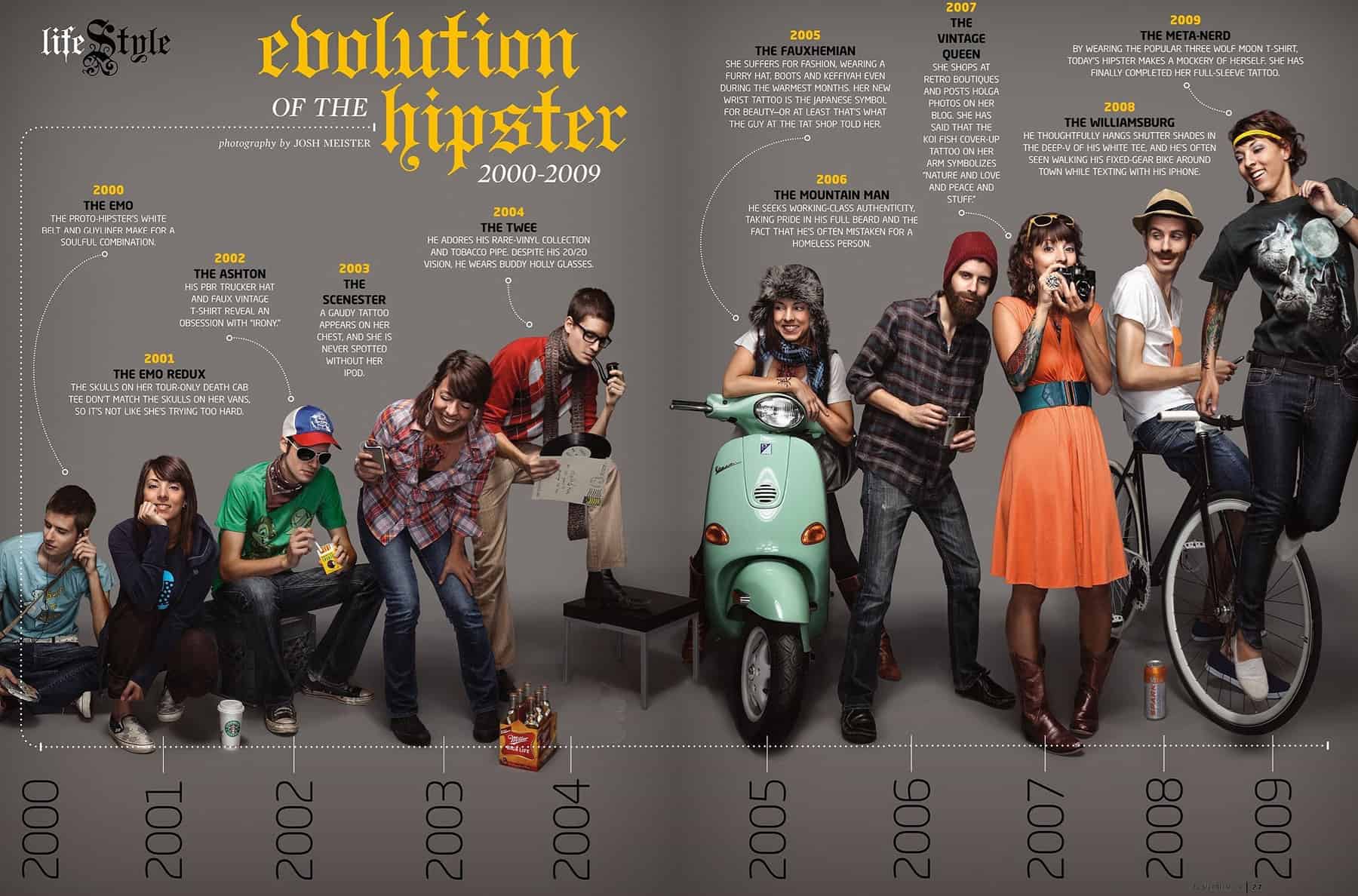
Here we can see the visual rhetoric of the hipster. The look of the hipster goes beyond mere clothing and accessories to the very way they stand. Hipsters often adopt a bad posture (like the guy on the bike), stand duck-footed (like the girl with the camera) sit on the floor in places where you should probably use a chair (the first dude). The visual creation the hipster tries to pursue is all in the name of not caring. At all.
From looking at the hipster movement, I have come to realize how important the visual aspect of rhetoric is. Rhetorically, hipsters fail. They have become the butt of multiple jokes, the laughing stock of society, the group that is looked down upon. Even the hipsters hate hipsters, as you will be hard pressed to find a self-identifying hipster. However, visually they work. Multiple clothing stores have made it copying the hipster aesthetic such as Urban Outfitters and Anthropologie. Their movement continues to grow due to those who adopt the hipster style without the hipster attitude behind it. The hipster movement works because of its aesthetics.
CITATIONS
Evolution of the Hipster. N.d. Daily InfographicWeb. 12 Dec 2012. <http://www.bing.com/images
/search?q=Hipster&view=detail&id=8C026E18C5B8174A6F8F5AFE393085DA11F64CCE&
first=36>.
Fletcher, Dan. "Hipsters." Time 29 Jul 2009, n. pag. Web. 12 Dec. 2012. <http://www.time.com
/time/arts/article/0,8599,1913220,00.html>.
Haddow, Douglas. "Hipster: The Dead End of Western Civilization." Adbusters 29 Jul 2008, n. pag.
Web. 12 Dec. 2012. <https://www.adbusters.org/magazine/79/hipster.html>.
Hergett, Rachel. "Is It Hip To Be A Hipster?." Bozeman Daily Chronicle [Bozeman] 12 Oct 2011, n.
pag. Web. 12 Dec. 2012. <http://www.bozemandailychronicle.com/news/lifestyles
/article_e589dcac-f462-11e0-aa4b-001cc4c002e0.html>.
The protesters in this video have an inconsistency when it comes to their arguments. They say one thing and do the exact opposite. This completely derails their argument and makes it so their audience cannot trust them.
This video shows exactly why the rhetoric of the Hipster Movement does not work. In order to be successful rhetorically, the speaker must gain the trust of the audience. They must have some sort of ethos. Hipsters have lost any ethos that they may have had because of their hypocrisy. They have no hope of gaining back that trust because they have no idea that they've lost it.
Another issue with their rhetoric is that their audience seems to be each other. The things that they wear, the issues that they fight for, and the hobbies they develop, as I said before, are only to be considered "cool," but not by the rest of society, whom they have rejected, but by each other. They tell each other things that they know the other person will want to hear. They care only for the opinion of other hipsters.
This is where I think rhetoric often fails. This same issue can often be seen in the political realm. Too often, politicians focus only on the audience of their party. They know what this audience want to hear and so they give it to them. They fail to focus beyond this audience, and are therefor unable to convince more than this audience of their side. For example, during this election, Romney said some things meant for a very specific audience: his financial supporters. He was speaking to a very specific group of upper class republicans. In order to gain their support, he said things that they wanted to hear about Obama voters. However, once the video was leaked, it became quickly apparent that this rhetoric was not meant for a wide audience and it was incredibly detrimental to his campaign. It is the same with the hipsters. Not only is their audience very narrow, but it is towards people exactly like them, much like in the Romney incident, and, therefor, they are unable to persuade others outside of their culture to hop onto their movement, understand their style, or think that they're "cool."
On the other hand, this is a movement that continues to grow. I myself have been accused of being a hipster on numerous occasions, more recently learning that many of my friends consider me the most hipster person they know. This is a common realization many come to have that they, in fact, may be hipster and they didn't realize it. Last year, the Bozeman Daily Chronicle wrote an article exploring just that. In the article, they interviewed a few hipsters in denial. Specifically, they said, "Lilly Herro, wearing skinny jeans and boat shoes, admitted she may be a closet hipster. Her already short hair now sports steps, or razor cuts, up one side – because she thought they were funny" (Hergett).
So why, even though it is shameful to admit, does the hipster rhetoric tend to continue to gain followers, even those such as myself who grudgingly admit to having multiple hipster tendencies?
It all comes down to the visual rhetoric. Although the stuff spewing from their mouths is blatantly hypocritical, they have an undeniable "cool" quality that is difficult to ignore. The true hipster adopts an I-don't-care attitude which almost creates their "coolness." It is not necessarily the clothes they wear that creates this attitude, but the way that they wear these clothes. The way that they act about their hobbies. Because they go against social norms, they stand out, and they look, if not good at least interesting, doing it. No one wants to get lost in the crowd. Hipsters don't. Even if the individual hipster may not stand out in the hipster group, the movement itself has gained a lot of attention.
Here we can see the visual rhetoric of the hipster. The look of the hipster goes beyond mere clothing and accessories to the very way they stand. Hipsters often adopt a bad posture (like the guy on the bike), stand duck-footed (like the girl with the camera) sit on the floor in places where you should probably use a chair (the first dude). The visual creation the hipster tries to pursue is all in the name of not caring. At all.
From looking at the hipster movement, I have come to realize how important the visual aspect of rhetoric is. Rhetorically, hipsters fail. They have become the butt of multiple jokes, the laughing stock of society, the group that is looked down upon. Even the hipsters hate hipsters, as you will be hard pressed to find a self-identifying hipster. However, visually they work. Multiple clothing stores have made it copying the hipster aesthetic such as Urban Outfitters and Anthropologie. Their movement continues to grow due to those who adopt the hipster style without the hipster attitude behind it. The hipster movement works because of its aesthetics.
CITATIONS
Evolution of the Hipster. N.d. Daily InfographicWeb. 12 Dec 2012. <http://www.bing.com/images
/search?q=Hipster&view=detail&id=8C026E18C5B8174A6F8F5AFE393085DA11F64CCE&
first=36>.
Fletcher, Dan. "Hipsters." Time 29 Jul 2009, n. pag. Web. 12 Dec. 2012. <http://www.time.com
/time/arts/article/0,8599,1913220,00.html>.
Haddow, Douglas. "Hipster: The Dead End of Western Civilization." Adbusters 29 Jul 2008, n. pag.
Web. 12 Dec. 2012. <https://www.adbusters.org/magazine/79/hipster.html>.
Hergett, Rachel. "Is It Hip To Be A Hipster?." Bozeman Daily Chronicle [Bozeman] 12 Oct 2011, n.
pag. Web. 12 Dec. 2012. <http://www.bozemandailychronicle.com/news/lifestyles
/article_e589dcac-f462-11e0-aa4b-001cc4c002e0.html>.

